Prysto
Organizations managing multi-location teams face growing operational complexity. Fragmented booking systems, opaque space utilization data, and workflows that resist digital transformation created a clear market gap — particularly as hybrid work exposed the limits of legacy tools built for a pre-distributed world.
Prysto was conceived to occupy the whitespace between enterprise facility management platforms and consumer calendar apps. The product vision was precise: an AI-powered workspace platform where every scheduling decision is informed by real data, conflicts are resolved before they surface to users, and the onboarding experience is fast enough to create immediate value.
AI was central to this from the start — not as a feature layer, but as the operating principle. Predictive conflict detection, real-time utilization analytics, and intelligent calendar synchronization required AI capabilities embedded into the core architecture rather than added on top.
Five structural problems that existing tools had failed to solve.
Double-bookings across buildings and floors burned coordination time and eroded trust in the system. Teams reverted to informal channels — Slack, email, walking over — creating invisible demand that no tool could see or address.
Organizations had no reliable data on how spaces were actually being used. Capacity decisions were anecdotal. Expensive rooms sat empty; in-demand rooms were chronically overbooked. The data existed in bookings — it just wasn't being read.
Teams operated across Google Calendar, Microsoft Outlook, and native applications without synchronization. This created parallel booking systems — one in the tool, one in personal calendars — with no reliable source of truth between them.
Distributed teams booking across timezones created consistent scheduling errors. The problem was treated as a display issue when it was actually a data architecture problem — every datetime needed to be a first-class domain object, not a formatted string.
Previous tools required too many steps. Any friction in the first booking experience resulted in users abandoning the product for informal coordination. The business case for change collapsed if the new tool felt harder than the old habits it was meant to replace.
AI-generated outcomes require a higher standard of transparency than manual workflows. When a system automatically resolves a conflict or reassigns a booking, users need to understand why — or they will override the system and lose trust in everything it does.
The discovery phase began with structured stakeholder interviews across three organizations — office managers, team leads, and individual contributors. Each group experienced the problem differently. Office managers saw wasted capacity; team leads saw scheduling overhead; individual contributors saw friction in finding a room and moving on.
Product workshops mapped the full booking flow from need to confirmation. The critical insight was quantitative: users would abandon any process that took longer than two minutes. The two-minute first booking became the north star metric — a constraint that shaped information architecture, form design, and data structure in equal measure.
Opportunity mapping identified three high-value intervention points: the moment a user searches for availability, the moment a conflict is detected, and the moment analytics data is surfaced to decision-makers. Each required a different AI capability — real-time conflict detection, predictive resolution, and automated pattern recognition.
AI capability assessment evaluated which capabilities were viable at MVP stage versus what required future model maturity. The product roadmap defined a clear sequence: core booking with intelligent conflict detection in phase one; calendar sync and utilization analytics in phase two; predictive scheduling and advanced reporting in phase three.
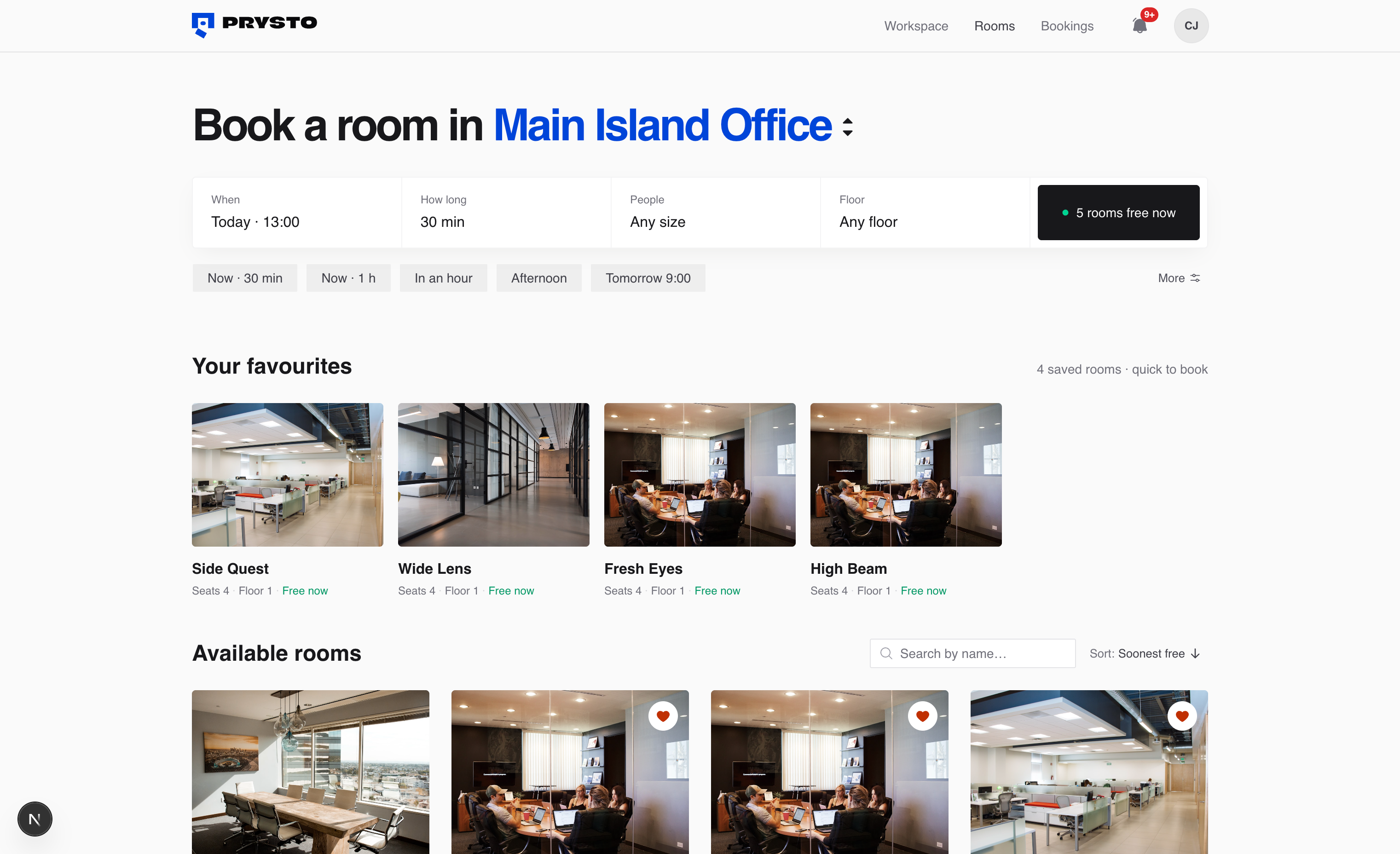
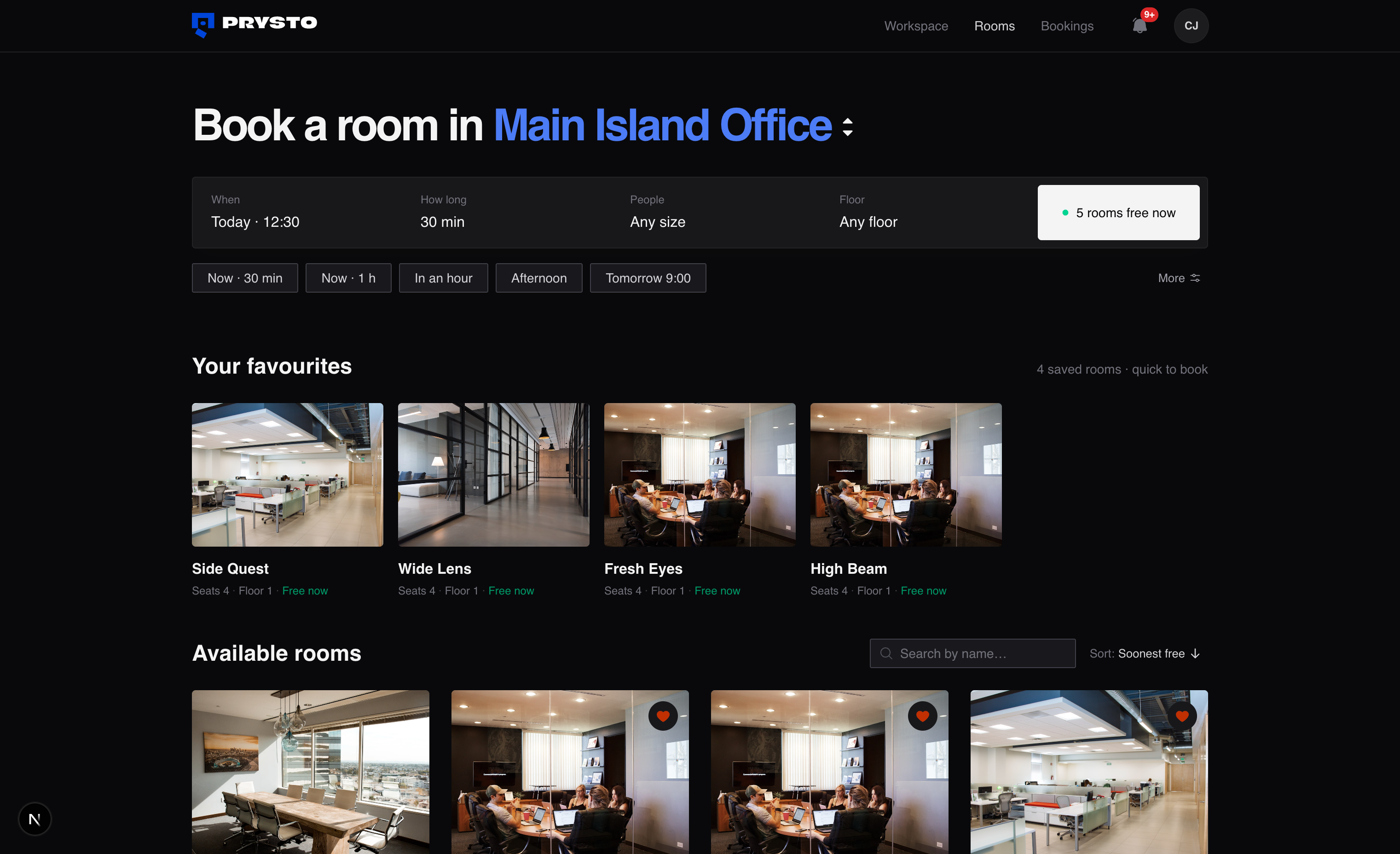
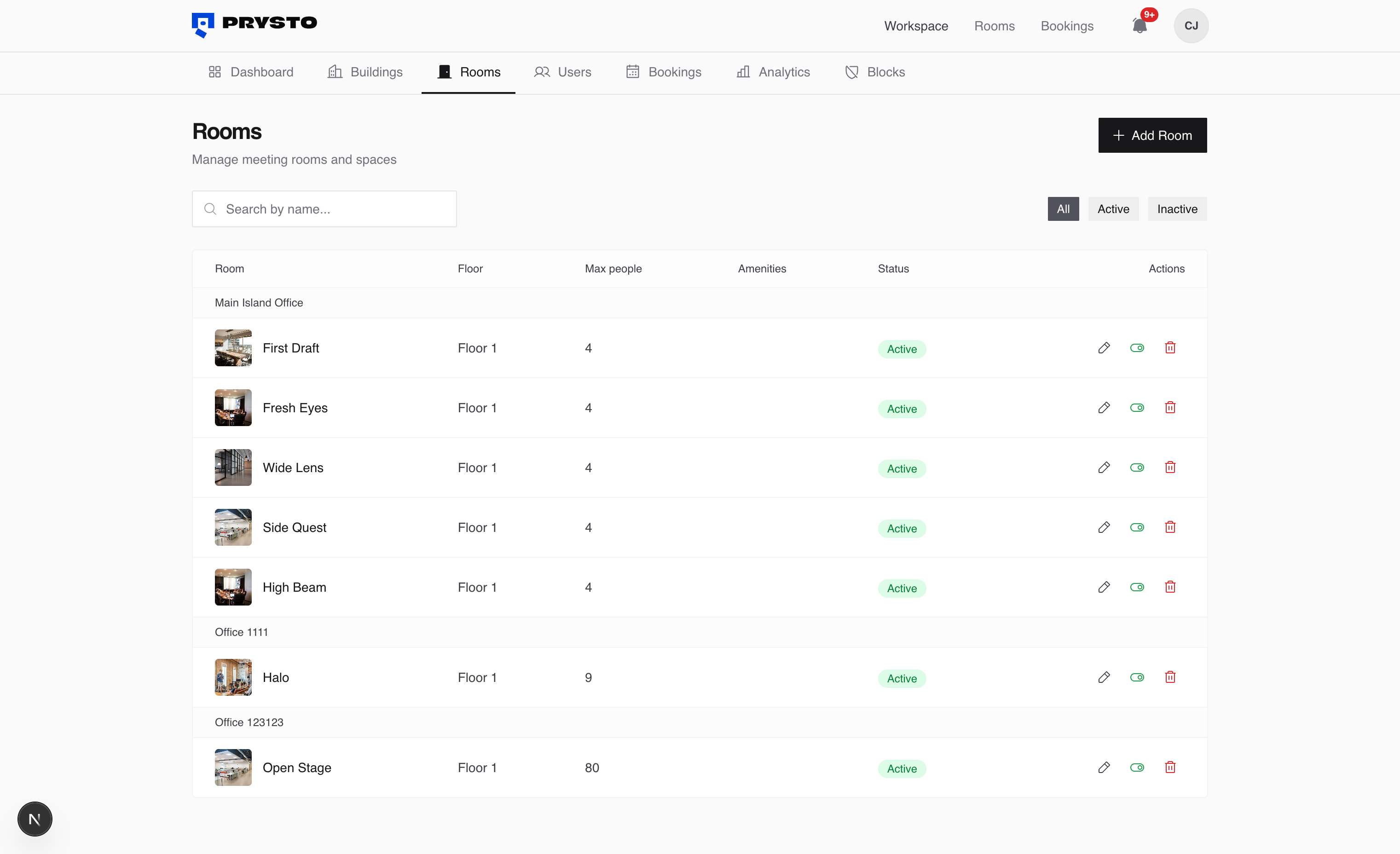
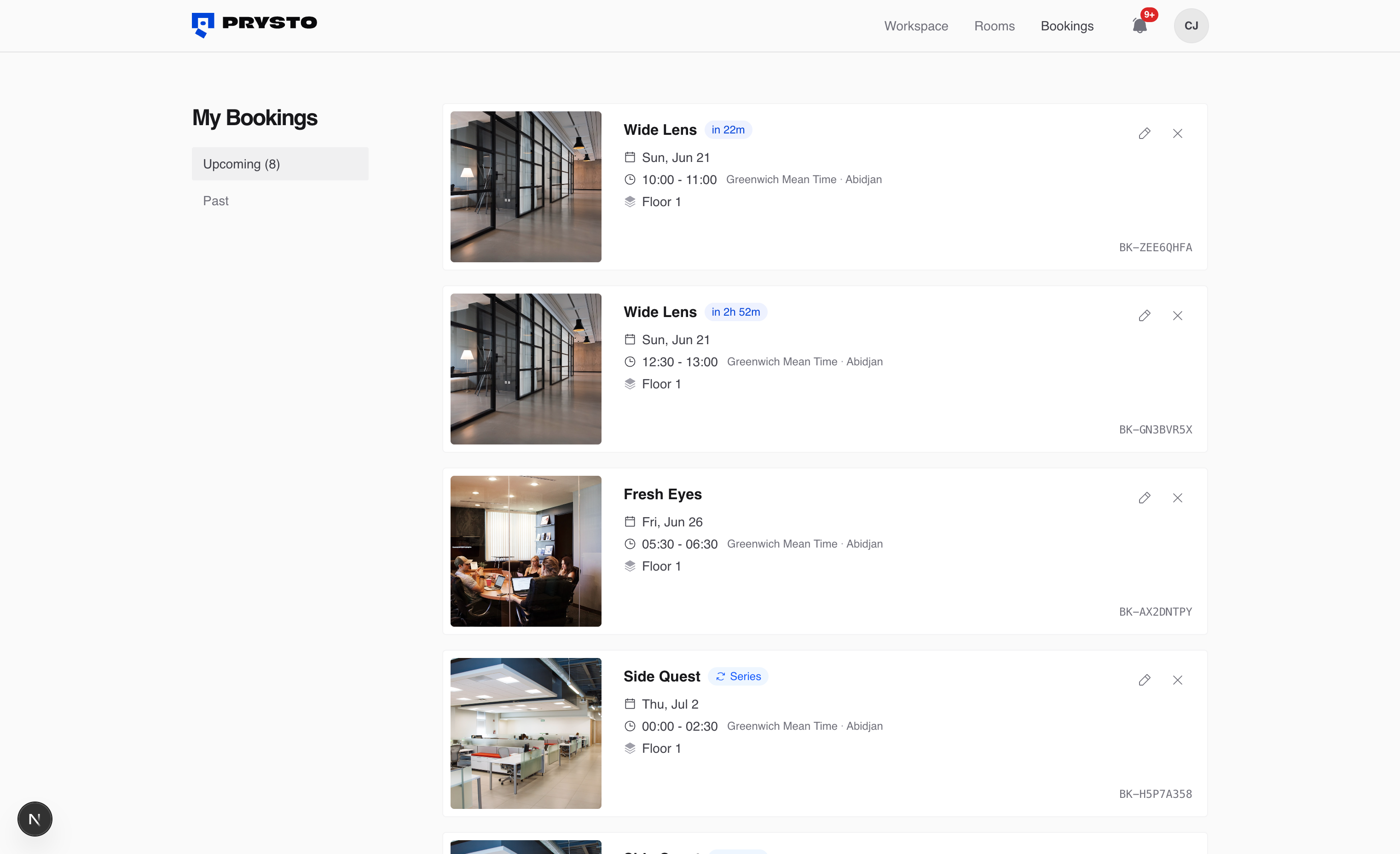
The application required five distinct surfaces to serve different user types and workflows: room discovery and booking, personal booking management, workspace analytics, administrative room management, and account settings. The challenge was keeping each surface focused without fragmenting the overall experience.
Information architecture was organized around the workspace hierarchy — Workspace → Building → Floor → Room → Booking. This hierarchy is not just a navigation model; it is the data model. Every piece of information belongs to exactly one level in this chain, and every user sees only the data that belongs to their workspace. The architecture made security and UX the same decision.
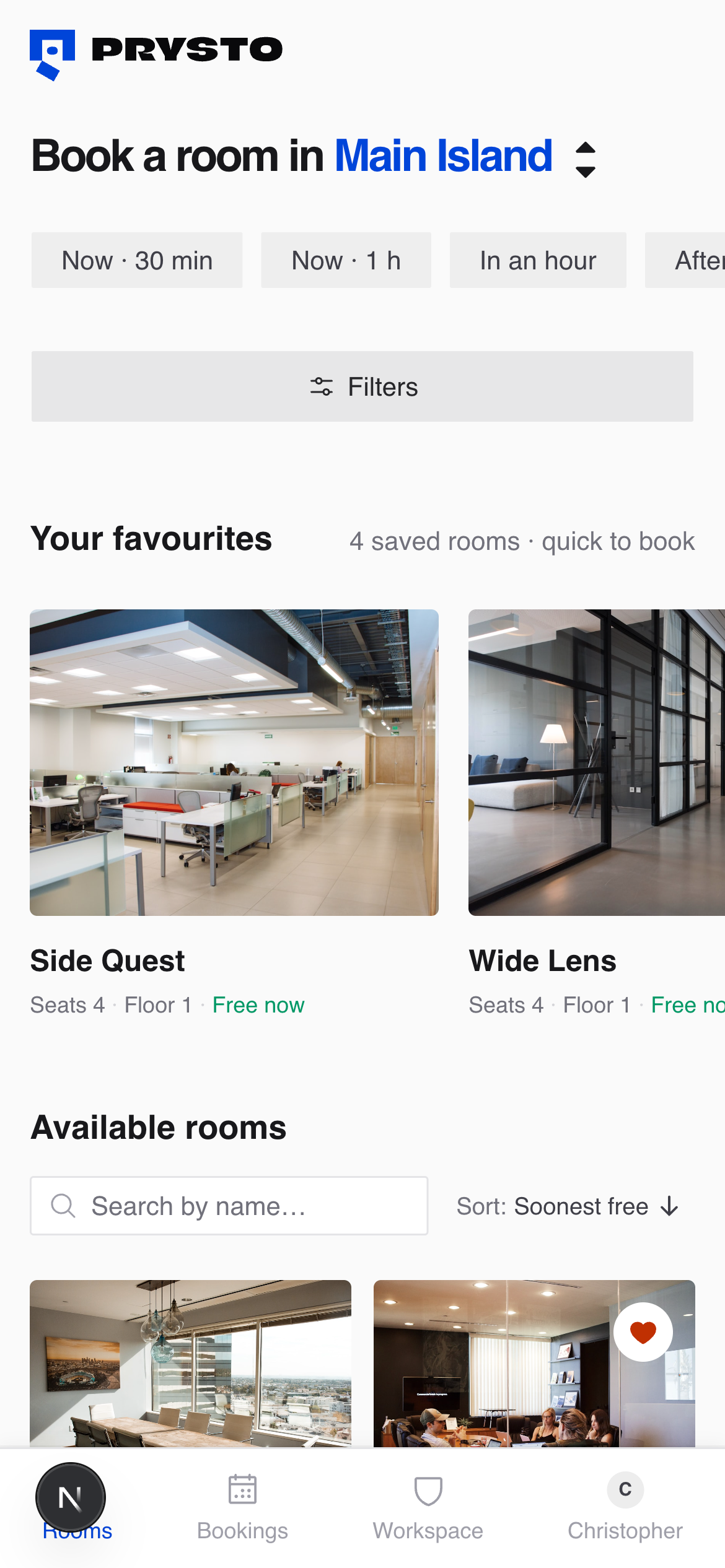
User journey optimization reduced the primary booking flow to four screens — search, select, confirm, done. The earlier eight-field form was stripped to three required inputs: room, date, and time range. Everything else was either inferred from context or deferred to settings.
AI-assisted interactions are embedded at the point of decision, not surfaced as a separate AI feature. Conflict detection appears inline during booking, not as a post-submission error. Utilization anomalies appear in the analytics view as contextual callouts, not in a separate AI dashboard. The goal was for users to benefit from AI without needing to think about it.
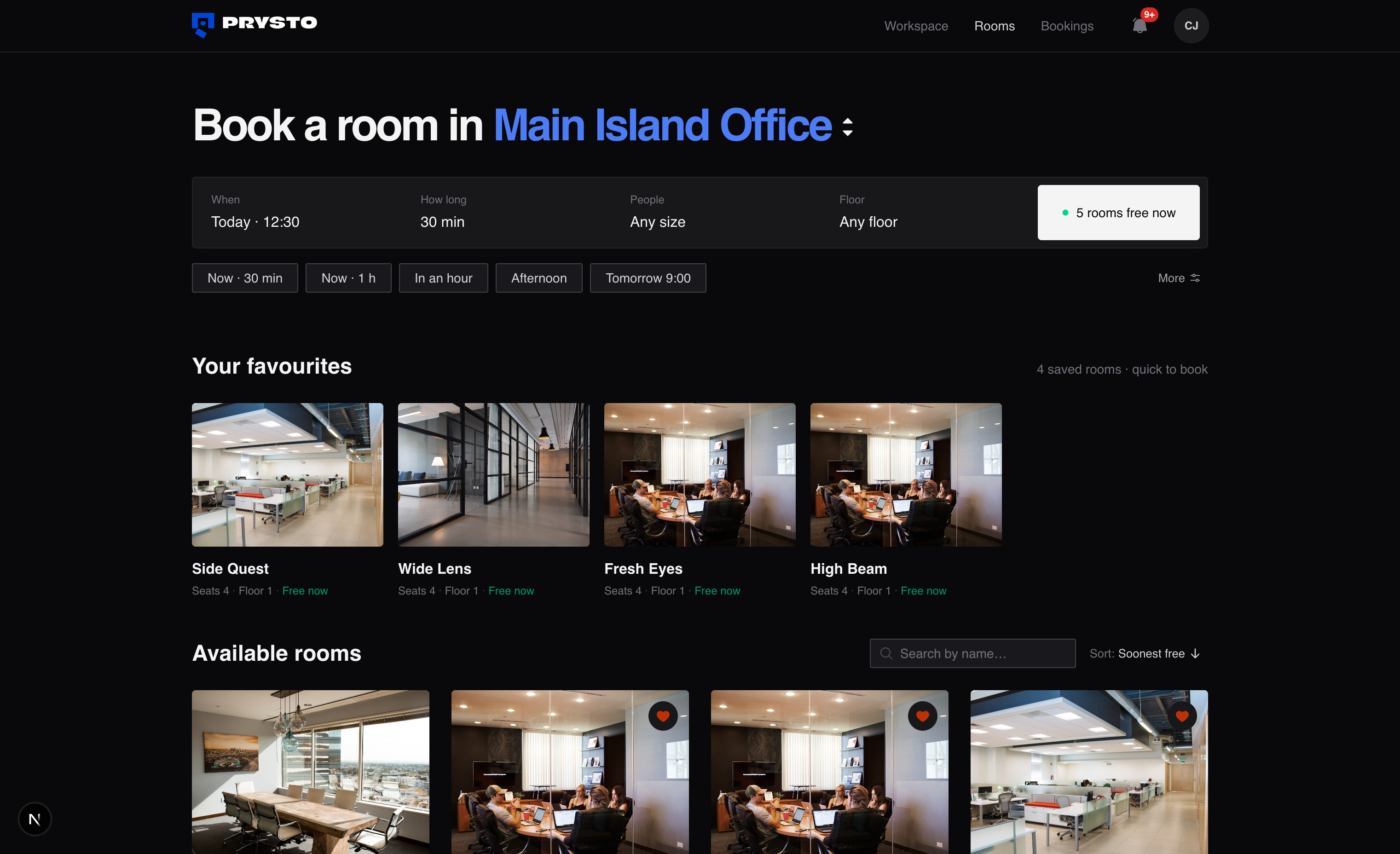
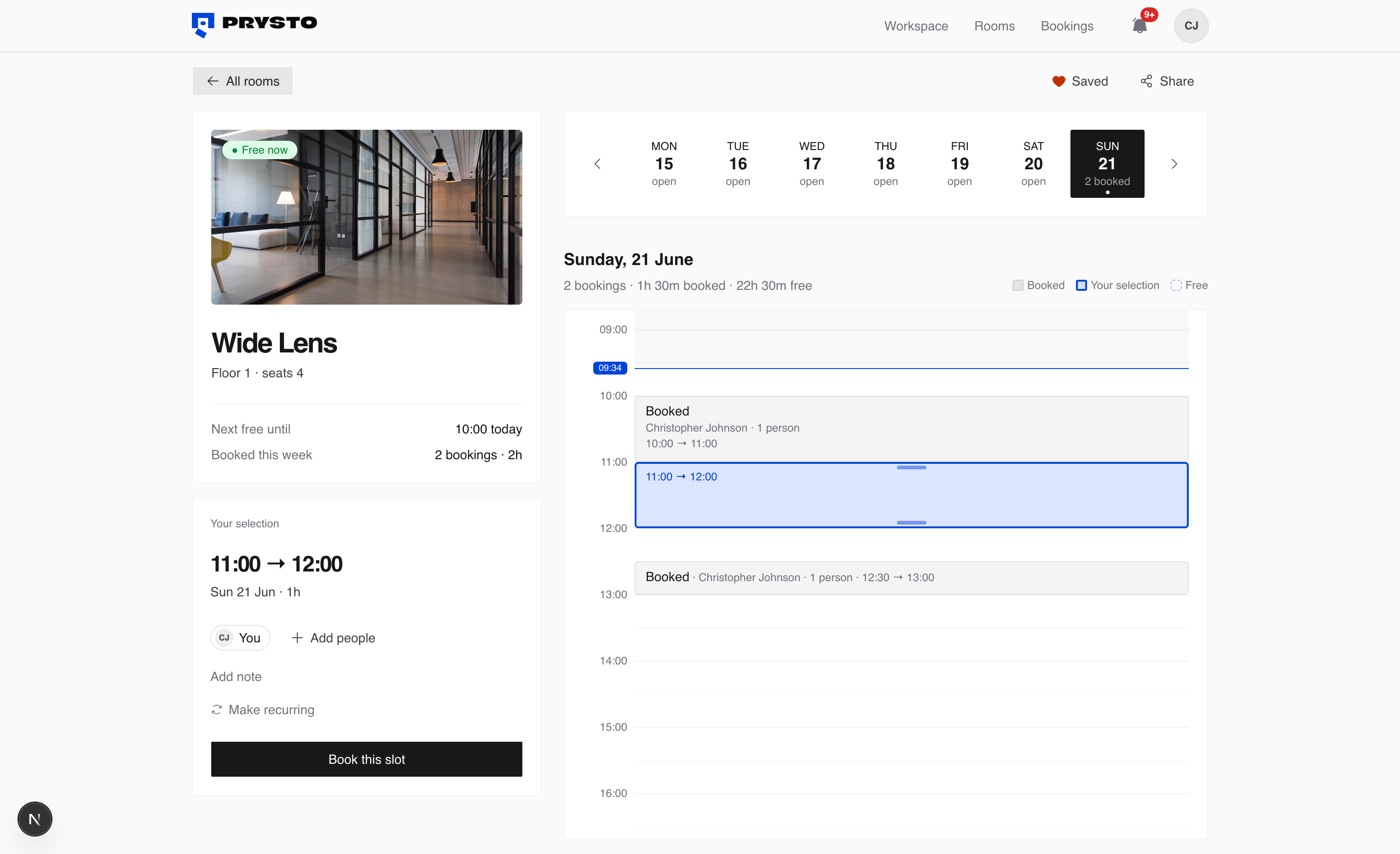
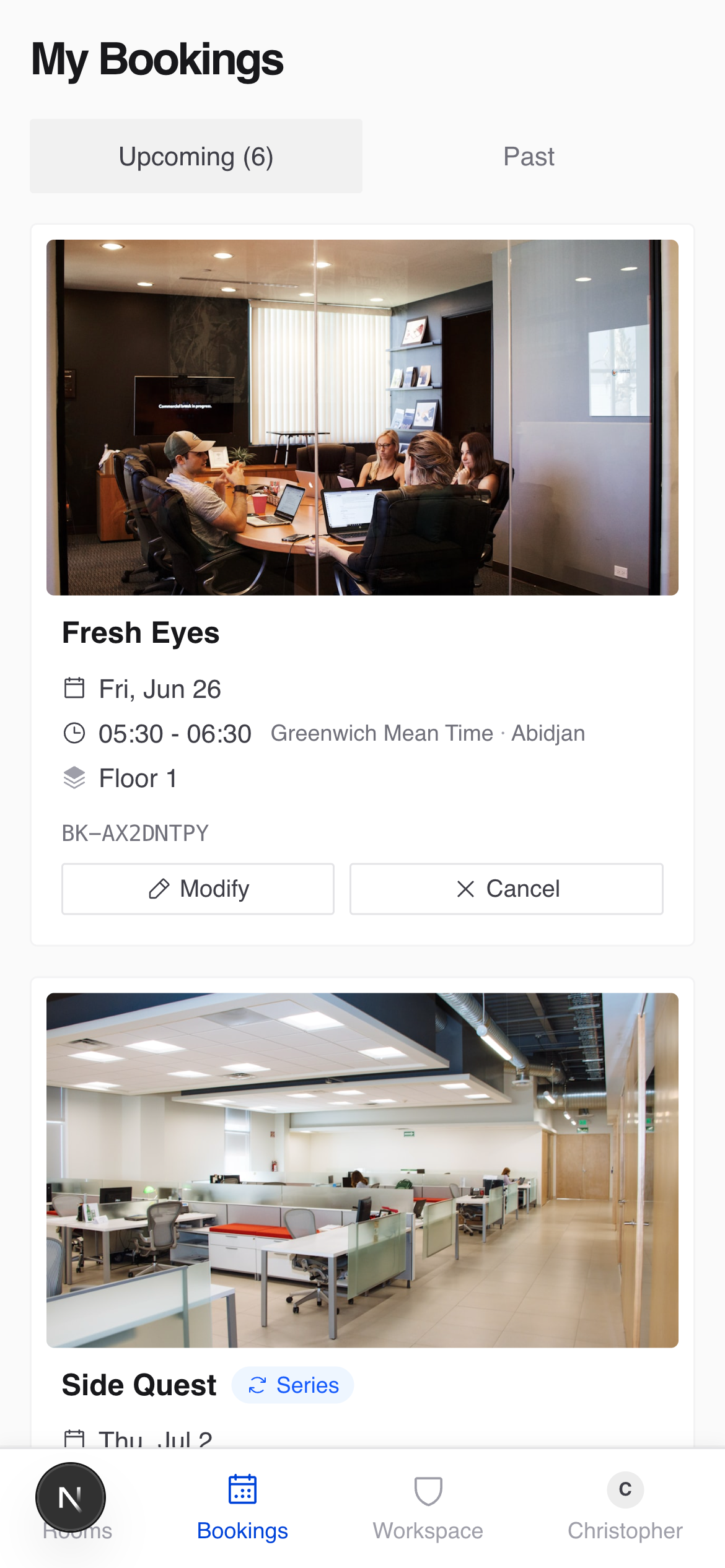
From an empty calendar to a confirmed booking — the whole flow, end to end, captured from the running app.
The Prysto design system was built around a single, load-bearing principle: one token layer, two complete themes. Every color value in the system is a semantic token — not a raw hex, but a meaning. Background, surface, border, muted, primary. Those tokens are re-pointed for dark mode without touching a single component.
Typography uses two typefaces with distinct roles. RL Madena handles display text — headlines, callouts, and the wordmark — bringing editorial weight to the product. General Sans handles interface text — labels, body, and data — at three weights across the full range of UI density.
Spacing is based on an 8px unit with a defined set of named scales. Every component uses spacing from this set. No arbitrary values. This creates the visual rhythm that makes the interface feel considered rather than assembled.
Components are headless in architecture — Base UI primitives with typed CVA variants. The entire system lives in the repository. No third-party component kit with its own design opinions. Every state, every variant, every animation is authored and owned by the product team.
Interaction patterns use optimistic UI updates powered by Convex realtime. A booking is reflected in the interface before the server confirms it. When conflicts are detected, the response is immediate — not a round trip away.
The principles that governed every AI-assisted interaction in the product.
01
Users understand what the system is doing and why. When conflict detection blocks a booking, it names the conflict — time, room, existing holder — rather than simply refusing. Transparency is not a UI feature; it is the prerequisite for trust.
02
Every automated action can be reviewed and overridden by a human. AI resolves the obvious cases. For everything else, it surfaces the decision clearly and defers to the person. Automation that cannot be corrected creates fragility, not efficiency.
03
The system communicates certainty through clear visual states rather than ambiguous indicators. Available, occupied, partially booked, pending sync — each state is visually distinct, immediately readable, and carries no hidden uncertainty. Users should never have to guess what the system knows.
04
AI reduces coordination effort without removing visibility. Users remain informed even when automation handles the routine. The measure of good AI in a product is not how much it does for the user — it is how much cognitive load it removes while keeping the user in the loop.
Six platform capabilities — each designed to eliminate a specific coordination failure and create measurable operational value.
AI-powered availability view with real-time conflict detection. Users evaluate rooms — capacity, location, availability timeline — in a single view without switching contexts or checking secondary calendars.
Business impact: Reduced time from search to confirmed booking to under two minutes for first-time users.
Bookings sync bidirectionally with Google Calendar and Microsoft Outlook, scoped per user. External conflicts are surfaced before the booking is confirmed — not discovered after the fact in a different application.
Business impact: Eliminated the parallel calendar problem — one source of truth across all scheduling surfaces.
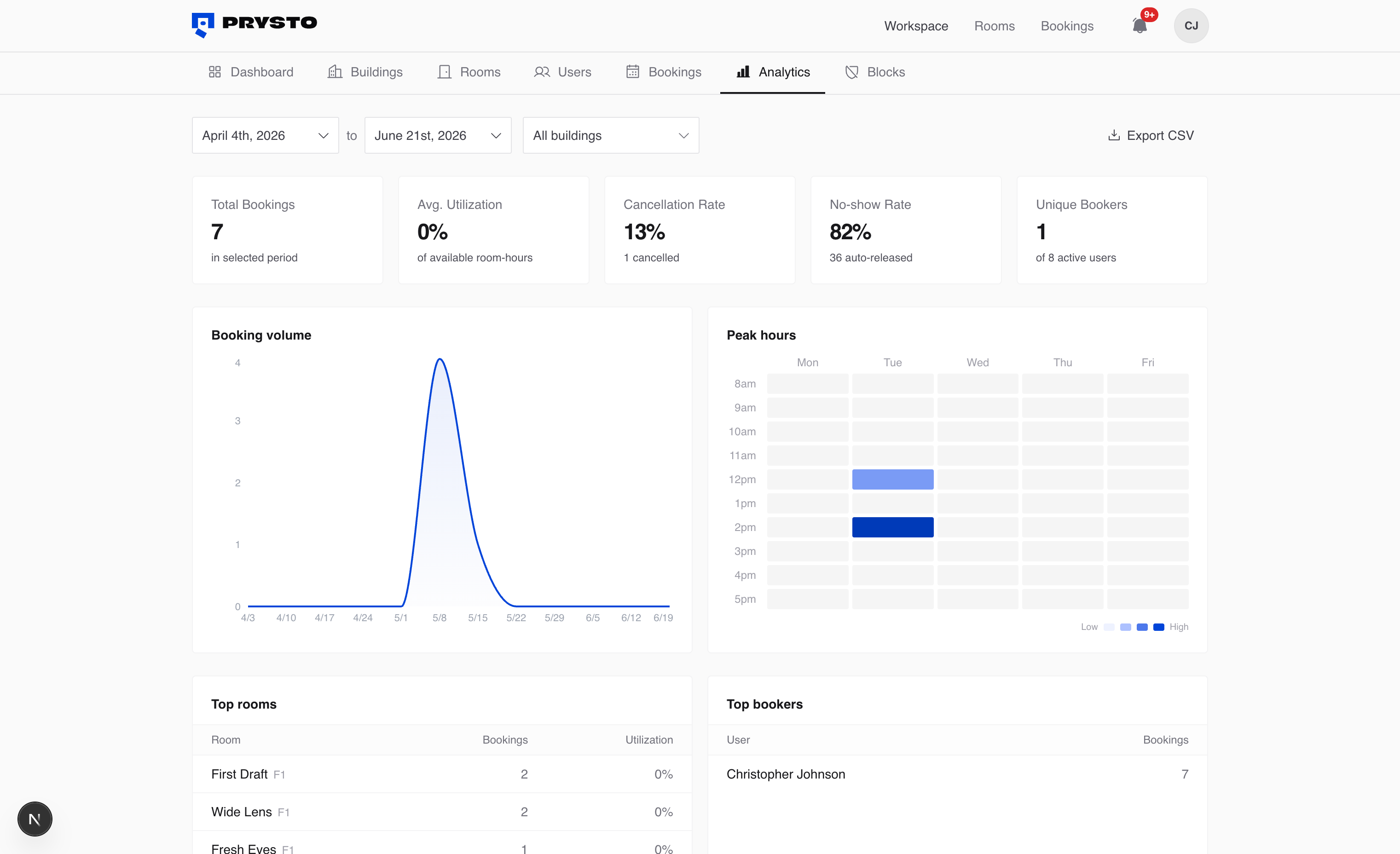
Utilization dashboard showing booking volume, peak hours, no-show rate, and top rooms — derived automatically from real booking data. No manual reporting, no estimation. The data is always current because it is the same data powering the bookings.
Business impact: Surfaced 73% utilization visibility where organizations previously had none — enabling data-driven capacity decisions for the first time.
Every query is workspace-scoped before it touches a row. One organization can never read another's data — this is a security guarantee enforced at the schema level, not a configuration option. The architecture makes correct behavior the only possible behavior.
Business impact: Zero cross-workspace data leaks. Security validated through architecture review, not just access controls.
<2 min
First booking — from zero to confirmed for new users
73%
Utilization visibility surfaced automatically from booking data
0
Cross-workspace data leaks — security enforced at schema level
1
Token layer powering two complete themes with no duplicated components
The two-minute first booking target was met in user testing before the product shipped to production — a result of the architecture decisions made in discovery, not optimizations applied after the fact. Utilization data was surfaced automatically from day one, without requiring any additional instrumentation or reporting layer.
Four reflections that will shape how we approach AI product work going forward.
Users need to understand what the system is doing, especially when automated decisions affect their schedule. Transparency is not a feature to be added after the core product is built — it is a prerequisite for adoption. Every automated action requires a legible explanation.
Two-way sync with Google and Microsoft exposes deep inconsistency between calendar providers. The abstraction layer — normalizing event models, handling auth revocation, managing sync state — became one of the most technically demanding parts of the product. It required treating calendar sync as a domain in its own right, not a utility.
The temptation in AI product work is to automate as much as possible. The learning here was that users want AI to reduce friction, not remove agency. Every automated decision needed a clear override path. The products that earn long-term trust are the ones that remain legible even when they're doing the work for you.
Treating timezone as an afterthought is a category of product failure, not a bug. It required designing every datetime as a first-class domain object from the architecture up — with explicit normalization rules, display contracts, and timezone-aware recurrence logic. The user experience of time is only as good as the data model beneath it.
Prysto launched as a coherent, scalable product with a clear architecture and a defined path from MVP to enterprise. The combination of design thinking grounded in user behavior, a data model built for correctness rather than convenience, and AI capabilities embedded where they remove real friction — rather than where they look impressive — created a product that earns trust through its first booking and maintains it through every subsequent session.
The two-minute first booking target became the organizing principle that shaped every decision across every discipline on the team. That is what good product strategy looks like in practice: a single, measurable constraint that forces the right tradeoffs before anyone writes a line of code.
Strategy, design, and AI development came together not as separate deliverables, but as a single product decision made consistently across every layer of the system.
Whether you're validating an idea or scaling an existing platform, we can help transform AI capabilities into products people actually use.
We'll review it and get back within 1–2 days with a clear scope and next steps.
Or book a 30-min Discovery Call via CalendlyWe'll walk through your idea and define exactly what it would take to build and launch.
Project Team
Product Design Lead
Vadim Zaycev
UI/UX Design and AI Development
Vova Tsurkan
