Remote usability testing and behavioral analysis for startups, SaaS, and AI products. We observe what analytics can't show — confusion, hesitation, trust, and emotional response.
What we uncover
Behavioral patterns that analytics tools cannot reveal.
Moments where users stop understanding what happens next. These are often silent — no error message, just a user who no longer knows what to do.
Places where users slow down, rethink their actions, or lose confidence. Hesitation before a CTA is often a signal of unclear value or trust gaps.
Specific interactions that reduce a user's confidence in your product. Trust breaks silently — users rarely say it, but their behavior shows it.
Screens that require too much effort to process. When users need to think too hard, they disengage — regardless of how well-designed the interface looks.
Pain points that make tasks harder than they need to be. Small friction accumulates — and users quietly stop completing the flows you designed for them.
How users actually feel while interacting with the product. Frustration, relief, uncertainty, and delight all leave observable traces in real sessions.
The gap
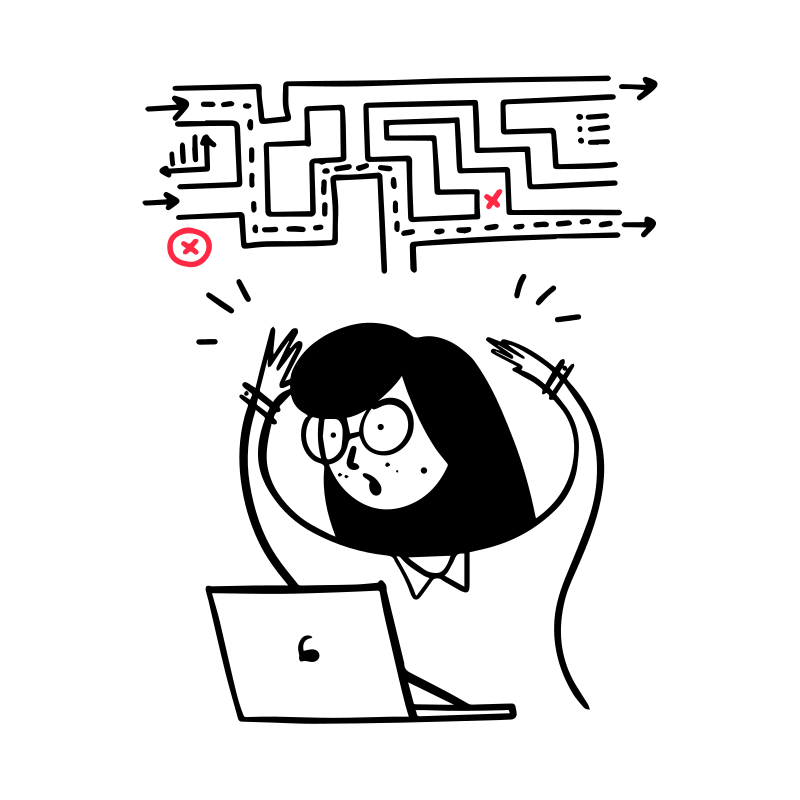
Built on assumptions
Familiarity blinds teams to friction. What feels obvious internally creates confusion for first-time users.
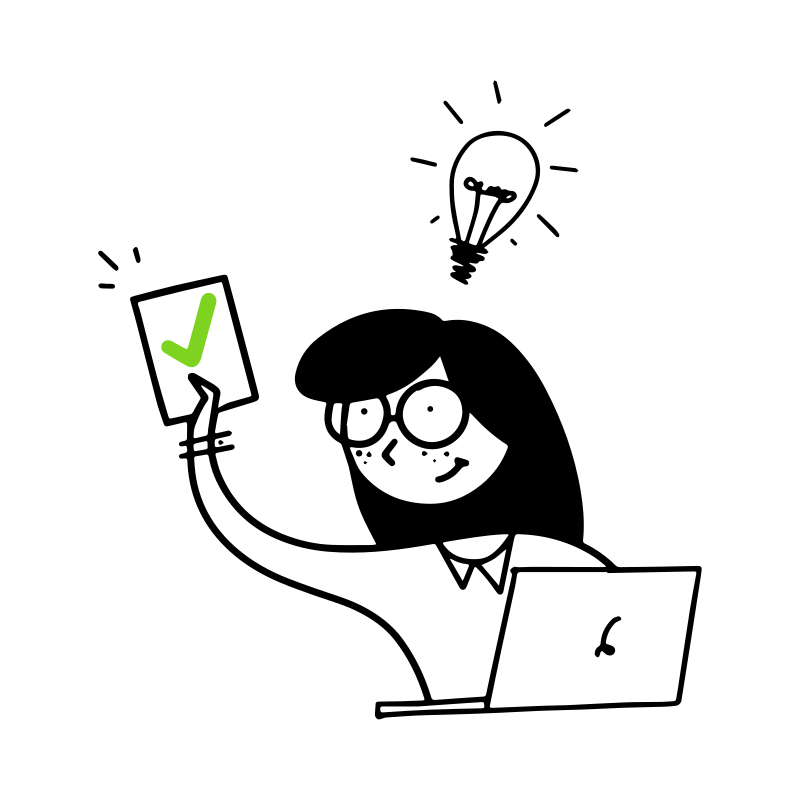
After a Human Experience Audit
Observed behavior — not assumptions or guesses — drives every recommendation.
How it works
Step 01
Step 02
Step 03
See it in practice
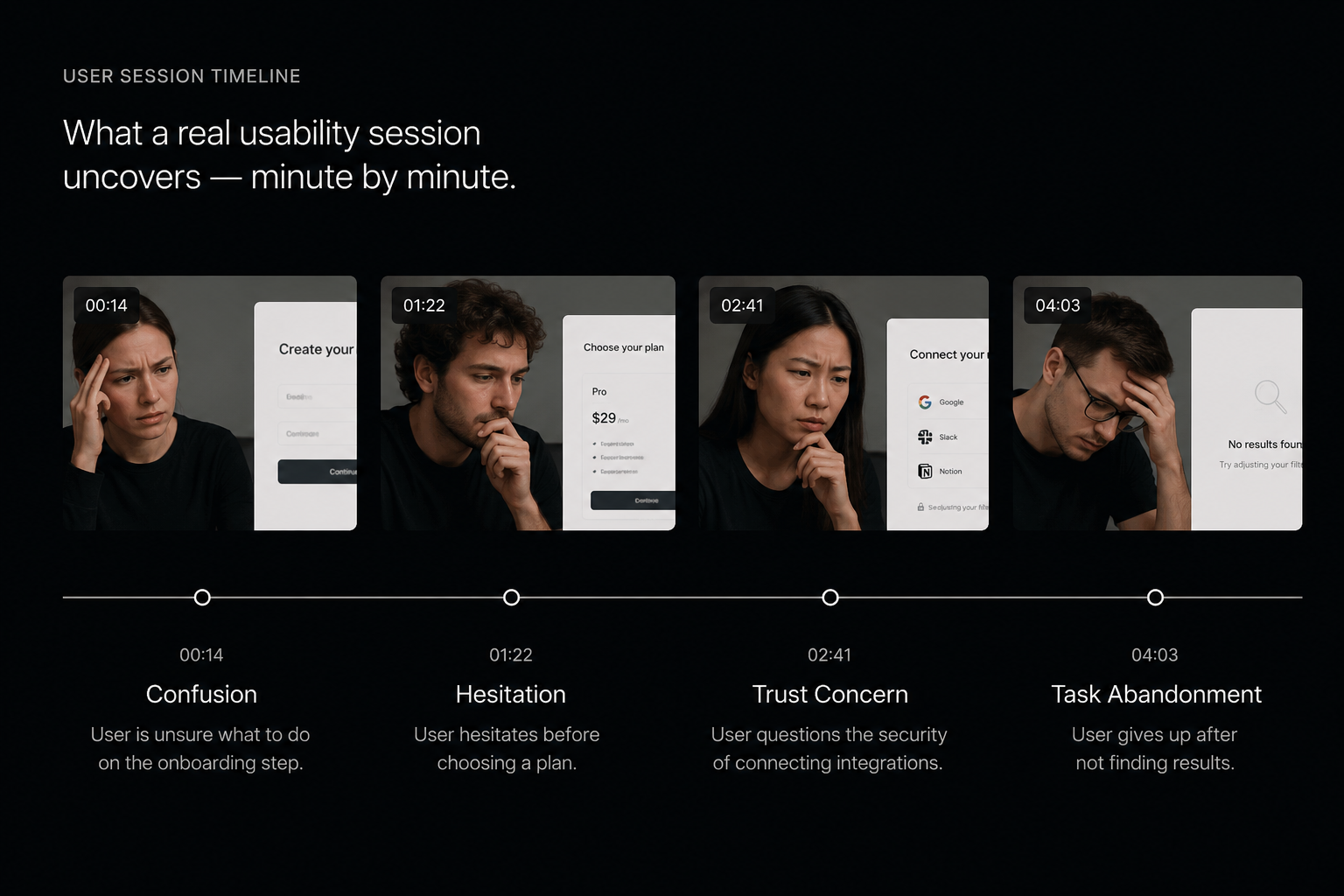
00:14Confusion during onboarding — user pauses and re-reads the same screen twice.
01:22Hesitation before the primary CTA — mouse hovers without clicking for 8 seconds.
02:41Trust concern appears — user reads pricing page and goes back without action.
04:03User abandons the task — no error, no feedback. Just a silent exit.
These moments are invisible in analytics. They are visible in human sessions.
Open session exampleWhat you receive
Every deliverable is grounded in what we actually observed — not assumptions or heuristics alone.

"Products are often built fast. Understanding humans takes longer. We observe where people hesitate, get confused, and lose trust — because that's where products fail in practice."

Trusted by




FAQ
A behavioral usability review based on real human interaction with your product. Instead of relying on expert opinion alone, we observe how real users navigate, hesitate, and respond — capturing confusion, trust breakdowns, and friction that standard audits miss.
Real users selected according to your target audience profile. We work with you to define the right participant criteria — role, experience level, industry, or any other relevant characteristic — before sessions begin.
Both formats are available. Moderated sessions allow follow-up questions and deeper behavioral observation. Async sessions provide scale and reduce scheduling friction. We recommend the format based on your product stage and research goals.
SaaS platforms, AI products, MVPs, web applications, mobile apps, ecommerce platforms, and interactive prototypes. If real users can interact with it, we can observe them doing so.
Analytics show what users did. Human observation shows why they did it. A heatmap tells you where users clicked. A usability session shows you that they clicked there because they were confused about where else to go. Both are valuable — but only one reveals intent.
Typically between 2 and 5 business days depending on scope, number of sessions, and product complexity. We agree on a clear timeline before starting and deliver findings in a structured report with a video walkthrough.
Further reading

A practical guide to observing user behavior — what to look for, how to structure sessions, and how to turn observations into actionable improvements.
Read on Medium →
Design decisions made without real user observation create products that feel right internally but fail in practice.
Read on Medium →
How observation, iteration, and validation shape better product decisions — and why the process matters as much as the outcome.
Read on Prototypr →Get started
Most product teams discover friction patterns they never expected. A session takes days, not months.
We'll review your brief and get back within 1–2 days with a clear scope.
